
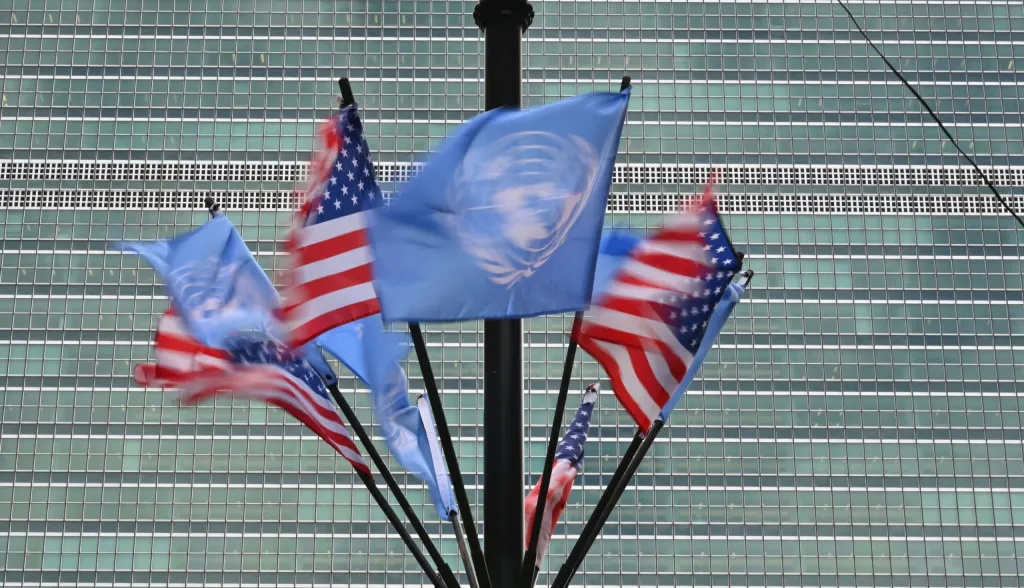
As the fragile US-Iran ceasefire teeters toward its April 22 expiration amid renewed Hormuz tensions and the US seizure of an Iranian vessel, a deeper structural rift is widening: the United States under President Trump is openly challenging the relevance of the United Nations. From withdrawing from 31 UN entities and dozens of other international organizations in January 2026 to prioritizing transactional deal-making over multilateral consensus, Washington is accelerating a shift from rules-based global governance to raw power politics.
This is not abstract diplomacy. The Iran war—launched by joint US-Israeli strikes on February 28, 2026, which killed Supreme Leader Ali Khamenei and degraded Iran’s nuclear and missile capabilities—has exposed the UN’s paralysis. While the UN Security Council remains polarized (with multiple vetoes and failed resolutions), the US has bypassed it, imposed a naval blockade, and pursued bilateral talks brokered by Pakistan. UN Secretary-General António Guterres has warned of “lawlessness breeds chaos” and criticized the massive US spending on the conflict amid aid budget cuts.
Highlight: “We are in this much more transactional geopolitical moment when member states do not see the security council as a mechanism through which they should be working for global peace.” — Senior UN official reflecting on US approach.
The Roots of America’s UN Reckoning
The Trump administration’s January 2026 executive order withdrew the US from 66 organizations, including key UN bodies like the UNFCCC (climate), UNFPA (population), and others deemed “wasteful, ineffective, or contrary to US interests.” Funding cuts and reviews followed, with Ambassador Mike Waltz emphasizing personal relationships over institutional flags.
In the Iran context:
- The US justified strikes without UN authorization, citing self-defense and regime threats.
- Post-strike, Washington enforced a Hormuz blockade and ship seizures despite UN calls for de-escalation.
- UNSC resolutions (e.g., Bahrain-led condemning Iranian actions) passed with US support, but broader reform efforts highlight Washington’s frustration with veto gridlock and perceived anti-US bias.
Think tanks like CFR and Brookings describe this as a “systemic rupture”: the US retreating from its post-WWII architect role toward selective engagement, forcing middle powers and regions to adapt.
Key Quote: “The US is redefining its role… prioritizing selective (often transactional) engagement… global institutions… no longer serve its national security interests.” — Analysis from SAIS Review.
Implications for the New World Order: Change of Hands in Global Governance
This US-UN friction signals a multipolar transition:
- Power diffusion: With UNSC deadlocked (eight vetoes in recent years across Russia, US, China), middle powers like Pakistan (mediating US-Iran talks) and BRICS actors fill voids.
- Erosion of norms: The Iran war—deemed by some international lawyers a Charter violation—highlights selective enforcement of international law.
- Economic and security ripple: Hormuz disruptions from the war underscore how unilateral actions destabilize global trade, pushing de-dollarization and alternative forums.
European reactions (detailed in the companion piece below) further isolate multilateralism, as the EU calls for diplomacy without military involvement.
Opportunities and Risks for Global Stability
Opportunities:
- Renewed UN reform debates, potentially making the body more effective.
- Space for think tanks and universities to model hybrid diplomacy (bilateral + regional).
- Pakistan-style mediation as a blueprint for middle-power bridging.
Risks:
- Further fragmentation: Weaker collective response to future crises (nuclear, climate, pandemics).
- Escalation in Iran: If talks fail, UN irrelevance could embolden unilateralism.
- Legitimacy crisis: Eroding trust in global institutions accelerates spheres-of-influence politics.
Think Tank Policy Recommendations
The World Think Tanks Council urges:
- Hybrid Diplomacy Forums: Launch “Post-UN Transactional Dialogues” co-hosted by think tanks, focusing on Iran-style crises.
- University Panels: Partner with global universities for simulations on US-UN reform and middle-power roles in conflict resolution.
- Awards for Adaptive Governance: Recognize diplomats and scholars advancing pragmatic multilateralism in a fragmented order.
- Scenario Planning: Joint white papers on nuclear thresholds and energy security, integrating UN remnants with bilateral tracks.
- Inclusive Membership Models: Invite universities and diplomats to contribute to a standing platform on global order shifts.
These steps can help navigate the transition without total collapse of norms.
Conclusion: A Defining Test for Multilateralism
The US-UN standoff, amplified by the Iran war, marks a pivotal “change of hands” in global power. While transactionalism delivers short-term results, the long-term risks demand balanced engagement. As Islamabad talks unfold, neutral platforms like the World Think Tanks Council are essential for evidence-based dialogue.
Call to Action
How can the UN adapt—or be replaced—in this new order? Submit your analysis, propose a university panel on multilateral reform, or nominate a diplomat for our awards. Register or contribute at worldthinktanks.com/contribute. Let’s shape sustainable global governance.